
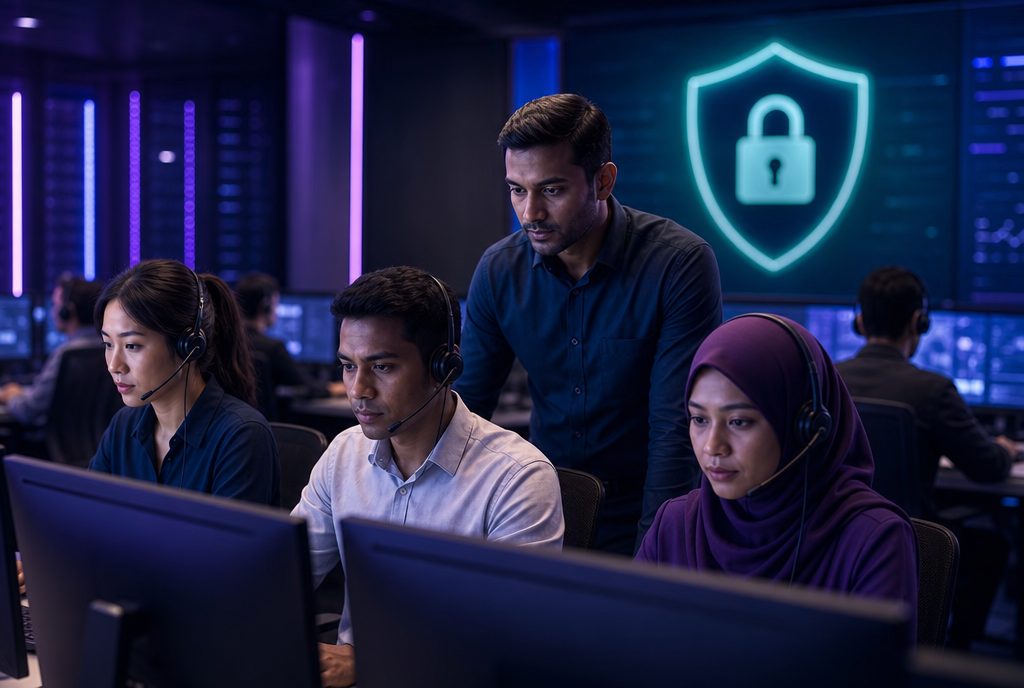
Data security and compliance in government contact centre outsourcing hinge on three things: certified information security management (typically ISO/IEC 27001), strict adherence to Singapore's Personal Data Protection Act (PDPA), and access controls that limit who inside the vendor's organisation can see what data. A public agency handing citizen data to a third-party contact centre is not just outsourcing a task, it is extending its own compliance obligations onto the vendor, which is why the vendor's security posture gets scrutinised as if it were the agency's own.
This scrutiny is warranted. A contact centre agent handling calls about permits, benefits, healthcare bookings, or law enforcement matters is routinely exposed to personal data, sometimes sensitive personal data, that would cause real harm if mishandled. The compliance bar for this kind of work is meaningfully higher than for a typical commercial customer service line.
What Does PDPA Compliance Actually Require of a Contact Centre?
The Personal Data Protection Act governs how organisations in Singapore collect, use, disclose, and secure personal data. For a contact centre, this translates into concrete operational requirements: consent management for data collected during calls, purpose limitation so data gathered for one government service is not repurposed elsewhere, defined retention periods, and breach notification obligations if something goes wrong.
A vendor holding the Data Protection Trustmark certification has had its PDPA practices independently assessed against a recognised standard rather than simply self-declaring compliance. This matters to agencies because PDPA liability does not simply disappear when data handling is outsourced. The agency remains accountable for how citizen data is treated, so it needs assurance that its vendor's practices will not create exposure it cannot see or control.
Why Self-Assessment Is Not Enough
Many vendors claim to be "PDPA compliant" without any external validation of that claim. For low-stakes commercial use cases this might be an acceptable risk. For government-adjacent work involving citizen records, health information, or law enforcement contact, agencies typically require independently verified certification rather than a vendor's own assurance, precisely because the downside of a breach is reputational and legal exposure for the agency, not just the vendor.
Why Does ISO/IEC 27001 Matter Specifically?
ISO/IEC 27001 is an internationally recognised standard for information security management systems. Certification means an organisation has documented how it identifies information security risks, implemented controls to address them, and submits to ongoing external audits to keep the certification current. It covers areas like access control, encryption practices, incident response, employee security training, and physical security of facilities.
Connect Centre Group holds ISO/IEC 27001:2022 certification alongside ISO 9001:2015 for quality management and ISO 22301:2019 for business continuity. The full certification list, along with award history, is published on the awards and certifications page. The combination matters because information security, quality, and continuity are related but distinct risk categories, and a vendor strong in one is not automatically strong in the others.
What ISO 27001 Covers That a Generic Security Policy Does Not
A vendor can write an internal security policy in an afternoon. ISO/IEC 27001 certification requires that policy to be backed by an actual risk assessment methodology, documented controls mapped to that assessment, and a surveillance audit cycle that checks whether the controls are still being followed months and years later. It is the difference between a security policy that exists on paper and one that has been tested against an external standard repeatedly over time.
What Access Controls Should Agencies Expect?
Beyond certification, agencies typically want specifics on how data access is restricted in practice. Reasonable expectations include:
- Role-based access so agents can only see the data relevant to the specific service they are handling, not a broader citizen database
- Segregation between different client accounts and government programmes running on the same contact centre floor
- Audit logging of who accessed what data and when, so any incident can be traced
- Defined offboarding procedures so access is revoked immediately when staff leave or change roles
- Physical security controls at the facility itself, not just system-level controls
These controls are particularly relevant for a facility like a ~180-seat call floor operating 24/7 across multiple countries, where dozens of agents may be handling different government and commercial programmes concurrently. Segregation between those programmes is not optional, it is a baseline expectation.
How Does Business Continuity Intersect With Data Security?
Security and continuity are often evaluated together because a service outage is itself a kind of failure, particularly for time-sensitive public services. ISO 22301:2019 certification for business continuity management means a vendor has documented plans for maintaining service during disruptions, whether that is a system outage, a natural event, or a staffing shortfall.
This is where a service like the 1777 Non-Emergency Ambulance Service becomes a useful illustration. It is a real, live 24/7 hotline within the Ministry of Health ecosystem, handling bookings and dispatch to Private Ambulance Operators licensed under the Healthcare Services Act. A service of this nature cannot have gaps in either data handling or uptime, since both a security lapse and a downtime incident could delay someone's access to medical transport. Running a service like this successfully over time is a meaningful proof point that security and continuity commitments hold up under real operating pressure, not just in a compliance document.
What Should Agencies Ask a Vendor About Data Security Before Signing?
Beyond checking certifications exist, agencies typically benefit from asking pointed questions: where is data physically stored and processed, does the vendor's cross-border operation (Singapore, Malaysia, Indonesia in Connect Centre Group's case) create any data residency considerations for this specific programme, what is the incident response and notification timeline if a breach occurs, and how is subcontracting handled if any part of the service touches a third party. The underlying technology and infrastructure a vendor runs also deserves direct questions, since security controls are only as strong as the systems they are built on.
These questions matter more for government work than commercial work because the agency cannot simply switch vendors quietly if something goes wrong. A data incident involving citizen information becomes a public accountability matter, which is precisely why the vetting process upfront tends to be so thorough. This ties directly into the broader evaluation criteria covered in our article on how government agencies choose contact centre partners.
How Does Staff Vetting and Training Factor Into Data Security?
Certifications and system controls only go so far if the people handling the calls are not properly vetted and trained. For government-adjacent work, agencies typically expect a vendor to have structured onboarding that covers data handling protocols specifically, not just general customer service training. Agents need to understand not only how to use the systems in front of them but why certain data cannot be discussed over certain channels, why call recordings exist, and what to do if a caller asks for information that falls outside what they are authorised to share.
This is also an area where organisational culture matters as much as policy. A vendor with a stable, well-trained workforce is generally a lower security risk than one with high turnover, because institutional knowledge about proper data handling tends to erode when staff churn is high and onboarding is rushed. Consistent staffing is partly why continuity certification and security certification tend to move together in practice, a stable operation is easier to keep secure.
Why Physical Security at the Call Floor Still Matters
It is easy to focus entirely on digital security and overlook the physical environment where calls are actually handled. A properly secured call floor restricts personal devices that could be used to photograph screens or record conversations, controls visitor access, and separates work handling sensitive government data from other operational areas. ISO/IEC 27001 certification requires these physical controls to be documented and audited alongside the digital ones, which is one reason the certification is treated as a comprehensive baseline rather than a narrow technical checkbox.
What Does Good Vendor Transparency Look Like During a Security Review?
Agencies conducting a security review as part of tender evaluation or ongoing vendor management typically look for more than a certificate number. A vendor confident in its security posture should be able to walk through its actual incident history (or confirm the absence of incidents), explain its audit findings from the most recent certification cycle, and describe concretely how a specific type of data would flow through its systems from the moment a call comes in to the moment the interaction is closed out.
Vendors that treat this kind of scrutiny as routine, rather than as an inconvenience, tend to be the ones that have genuinely built security into their operating model rather than bolting it on for the purposes of winning a tender. This distinction becomes especially visible when the service in question is not hypothetical. Operating something like the 1777 Non-Emergency Ambulance Service on an ongoing, live basis means data security practices are tested constantly by real call volume, not just by an annual audit.
Frequently Asked Questions
Does PDPA apply when a government agency outsources a contact centre?
Yes. Outsourcing a function does not remove the originating agency's accountability for how personal data is handled, so PDPA obligations effectively extend to the vendor's operations, and agencies typically require contractual and certification-based assurance of compliance.
What is the difference between ISO 27001 and the Data Protection Trustmark?
ISO/IEC 27001 is an international information security management standard covering the full range of security controls and risk management processes. The Data Protection Trustmark is a Singapore-specific certification focused specifically on PDPA-aligned data protection practices. Many mature vendors hold both, since they cover overlapping but distinct ground.
Why does business continuity certification matter for data security?
Business continuity (ISO 22301) and information security (ISO 27001) are related because both address different failure modes that can disrupt a citizen-facing service, one through a security breach and the other through an operational outage. Agencies evaluating a vendor for sensitive or critical services typically want to see both addressed, not just one.
How often are ISO certifications re-audited?
ISO certifications are not one-time awards. They require periodic surveillance audits, typically annually, with full recertification audits on a multi-year cycle, to confirm the organisation is still meeting the standard's requirements in practice, not just at the point of initial certification.
What happens if a contact centre vendor has a data breach involving government data?
The specifics depend on the contract and the nature of the breach, but agencies generally require immediate notification, a defined incident response process, and cooperation with any investigation. This is why vendors with certified, audited security management systems and documented breach response procedures are strongly preferred over those without.
Agencies or public-sector vendors wanting to discuss data security requirements for a specific programme can contact Connect Centre Group directly to walk through certification evidence and access control practices.