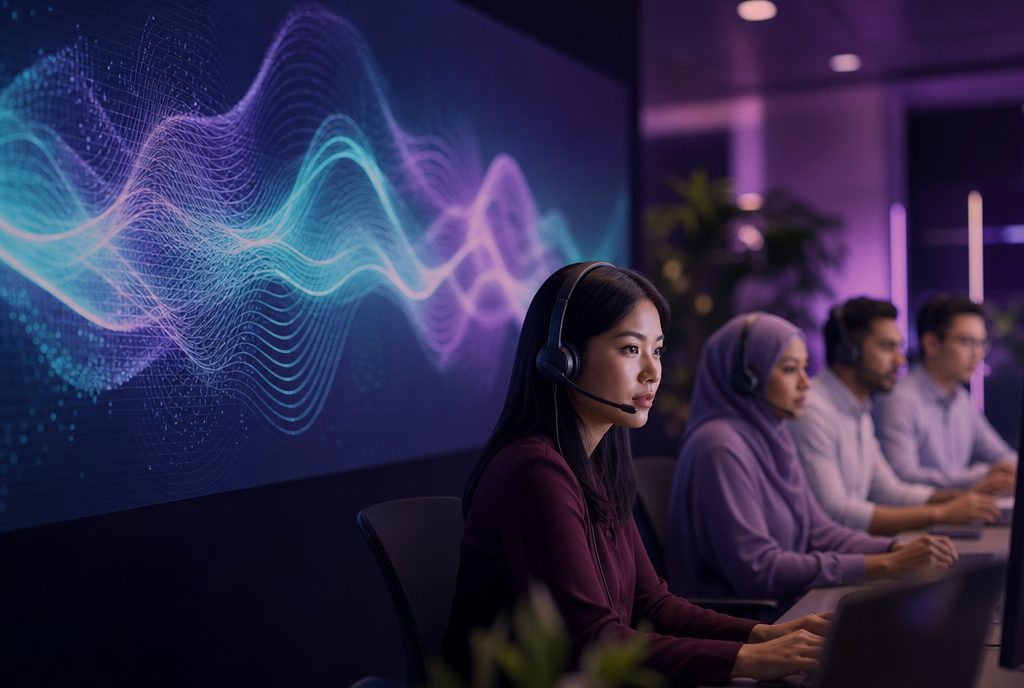
Speech analytics is software that automatically transcribes and analyses recorded customer calls to surface patterns in language, tone, and topic that would take a human team months to find by listening manually. It flags recurring complaints, compliance risks, and coaching opportunities across thousands of interactions at once, turning a backlog of audio nobody has time for into a short list of things worth acting on. For a contact centre handling even a modest volume of calls, this is often the difference between reacting to a problem after it has cost customers and catching it while it is still small.
Most contact centres record every call for quality and compliance reasons, and then almost never listen to more than a tiny sample of them. A supervisor might review a handful of calls per agent per month, usually chosen at random or flagged by a complaint. That sample is too small to say anything reliable about what is actually happening across the floor. Speech analytics changes the maths: instead of sampling one percent of calls, you can analyse all of them, and instead of listening for what you already expect to hear, the software surfaces what is actually there.
What Does Speech Analytics Actually Do?
At its core, speech analytics takes recorded audio, converts it to text through automatic transcription, and then applies analysis on top of that text. The analysis layer is where the value sits. It can search for specific words and phrases across every call in a period, group calls by topic without anyone having to tag them manually, measure things like talk-to-listen ratio and interruptions, and detect tone and sentiment shifts within a single conversation.
Transcription as the Foundation
Transcription accuracy matters more than it sounds. A tool that consistently mishears one common phrase for another will miss a meaningful chunk of the calls you most want to find. Singapore contact centres handling English, Mandarin, Malay, and Tamil calls need to check that a speech analytics tool actually performs well across the languages and accents their agents and customers use, not just in a demo built on clean American English audio. This is one area where a general-purpose platform can quietly underperform in a genuinely multilingual market.
Pattern Detection Beyond Keywords
Simple keyword spotting was the first generation of this technology, and it is still useful, but it misses a lot. Someone frustrated with a delayed refund might never use the obvious complaint words at all. More capable speech analytics looks at phrasing, hesitation, repeated questions, and escalation language to infer what a plain keyword search would miss entirely.
What Kinds of Insight Does It Surface?
The practical value of speech analytics shows up in a few recurring categories, and it is worth being specific about them rather than treating insight as one vague blob.
- Emerging complaint patterns, where a new product issue, billing error, or website bug generates a spike in calls mentioning the same thing days before it would otherwise reach a manager's desk.
- Compliance and script adherence, confirming whether agents are actually giving required disclosures, especially in regulated categories like financial services where outsourced financial support carries real regulatory weight.
- Coaching opportunities, flagging calls where an agent struggled with a specific objection or product question so a supervisor can review that exact moment rather than a random ten minutes of audio.
- Root cause of repeat contacts, identifying when customers are calling back because the first resolution did not actually solve their problem.
- Competitive and product intelligence, picking up mentions of competitors, pricing complaints, or feature requests that a product team would otherwise never hear.
How Does This Change Day-to-Day Operations?
The honest answer is that speech analytics only creates value if someone acts on what it finds. A dashboard full of interesting charts that nobody reviews weekly is a wasted licence fee. The centres that get real value from it build a routine around it: a standing weekly review where a supervisor or quality lead looks at the top emerging themes, decides which ones need an agent-facing fix (a coaching note, a script update) and which need to be escalated to the client (a product issue, a policy gap), and closes the loop by checking whether the pattern actually reduces the following week.
Feeding the Coaching Loop
Speech analytics pairs naturally with structured coaching. Instead of a supervisor guessing which calls to review, the software points to the calls most likely to contain a teachable moment: the ones with long silences, repeated customer questions, or sentiment that turned negative partway through. That focuses limited coaching time on the calls where it will do the most good, which matters more in high-volume environments where a supervisor genuinely cannot listen to everything.
Feeding Quality Assurance
Traditional QA scorecards rely on a human listening to a sample and marking boxes. Speech analytics does not replace that judgement, but it can pre-screen which calls are worth a human ear, and it can check adherence to required openings, disclosures, or closing statements automatically across the full volume rather than a sample.
What Should You Look For in a Provider?
Not every contact centre needs to buy and run speech analytics software itself. For many businesses, the more practical route is choosing an outsourced partner that already has this capability built into how it runs its floor, rather than adding another vendor and integration project. When evaluating that, a few questions are worth asking directly.
- Language coverage, confirmed with real accuracy figures for the specific languages your customers use, not broad marketing claims about supporting dozens of languages.
- Integration with the phone system, since speech analytics is only as good as the recordings and metadata it receives; a mismatch here is one of the quieter problems that shows up when comparing cloud PBX versus legacy phone systems.
- What happens with the output, meaning does the provider actually run a review cadence and share findings with you, or does the data sit unused in a system you never see.
- Data handling and retention, since call transcripts often contain personal and sometimes sensitive information and need to be handled under PDPA obligations with clear retention and access rules.
Where Does This Fit Alongside Broader AI Adoption?
Speech analytics is one of the more mature and lower-risk applications of AI in a contact centre, compared to things like fully automated conversational agents. It does not talk to customers directly, so the downside of an imperfect model is a missed insight rather than a bad customer experience. That makes it a sensible starting point for a business cautious about AI in the call centre more broadly: it improves the humans already doing the work rather than replacing the interaction itself.
It also compounds well with other technology investments. A contact centre that has already unified its data through good CRM integration can connect speech analytics findings back to specific customer accounts and order histories, turning a pattern in the audio into a specific, actionable list of accounts to follow up with rather than a general theme.
Is the Investment Worth It for a Smaller Operation?
Scale matters here. A centre handling a few hundred calls a month can often get most of the value through disciplined manual sampling and good supervisor habits. Speech analytics earns its cost once volume is high enough that manual listening genuinely cannot keep pace, or once the cost of missing a pattern (a compliance gap, a product issue driving repeat calls) is high enough that even a partial improvement pays for itself. Many businesses find the more realistic path is not buying the software outright but working with an outsourced partner who has already made that investment and folds it into the service, which avoids the licensing and integration cost while still getting the benefit of the insight.
Frequently Asked Questions
Does speech analytics replace the need for a quality assurance team?
No. It changes what the QA team spends its time on rather than removing the need for human judgement. The software is good at surfacing which calls are worth a closer listen and at checking mechanical things like required disclosures, but deciding what a pattern means and how to coach an agent still needs a person.
Can speech analytics work accurately across English, Mandarin, Malay and Tamil calls?
It depends heavily on the specific tool and how well it has been trained on those languages and the accents common in Singapore. Accuracy varies a lot between providers, so it is worth asking for real performance figures on your actual language mix rather than accepting a general multilingual claim.
How long does it take to see useful patterns after switching on speech analytics?
Basic keyword and topic patterns can appear within the first few weeks once there is enough call volume to be meaningful. More nuanced patterns, like early signs of a new complaint category, tend to become reliable after a month or two once the system has enough historical data to compare against.
Is analysing recorded calls a PDPA concern?
Call recording and analysis needs the same PDPA discipline as any other collection of personal data: clear notice to customers, a defined retention period, and controlled access to transcripts and recordings. Businesses handling regulated categories, such as financial services, should apply the stricter data security standards that sector expects.
Do we need our own speech analytics licence, or can an outsourced partner provide this?
Most businesses do not need to buy and manage the software themselves. Many outsourced contact centre partners already run speech analytics as part of their standard operation, which avoids a separate licensing and integration project while still delivering the insight.
If you would like an honest, practical view on this for your own business, get in touch via Connect Centre Group's contact page.