
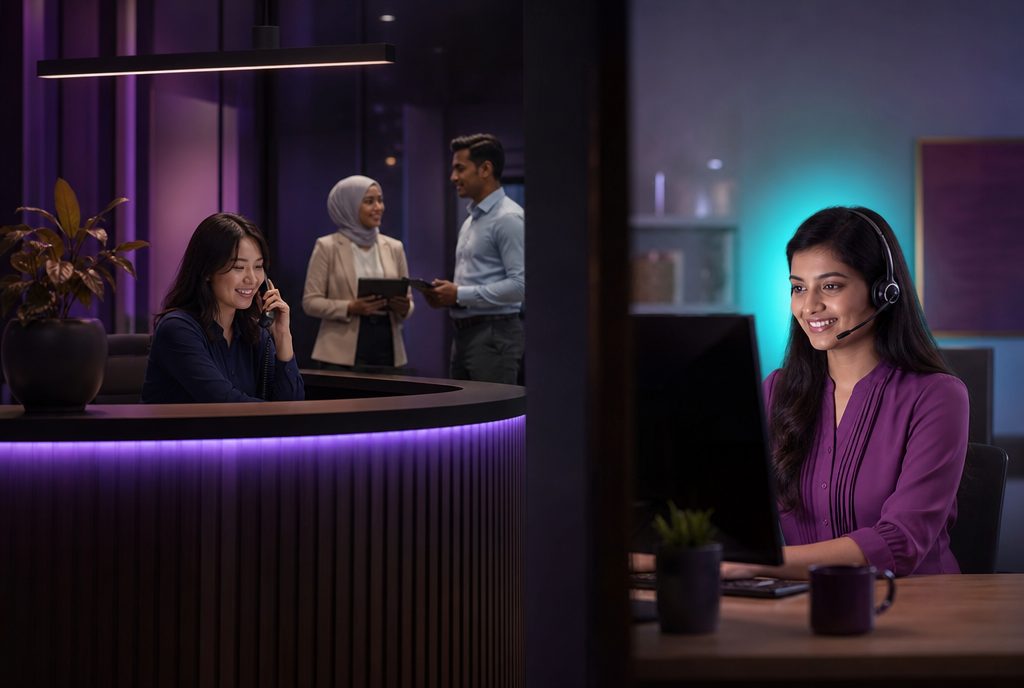
A virtual receptionist typically costs less and offers wider coverage hours than an in-house front desk hire, while an in-house receptionist offers more direct control and a physical presence in your office. Neither option is universally better: the right choice depends on your call volume, budget, whether you need someone physically present, and how much your business needs to scale up or down. This article walks through the real trade-offs so you can self-select with confidence.
What's the Real Cost Difference?
An in-house receptionist comes with a full-time salary, CPF contributions, annual leave, medical benefits, and the ongoing cost of training and eventual replacement if they leave. You're also paying for hours when the phone isn't ringing, and for a desk, equipment, and software licences dedicated to one role.
A virtual receptionist service is typically structured around call volume or a monthly plan, meaning you pay for the coverage and capacity you actually use rather than a fixed headcount. There's no recruitment cost, no CPF or benefits administration, and no gap in coverage when someone is on leave or resigns. For many small and mid-sized businesses, this is the single biggest driver toward a virtual model, especially in the early stages when call volume doesn't yet justify a dedicated salary.
That said, cost isn't the only variable. A business with very high call volume and specialised, complex enquiries might find a well-trained in-house team more cost-effective per call once volume passes a certain threshold. It's worth modelling your actual call numbers, including the hidden hours a receptionist spends waiting between calls, rather than assuming one option is cheaper by default.
It's also worth accounting for the cost of a missed call, not just the cost of answering one. A single-hire front desk has no backup when that person is at lunch, on leave, or already on another line, and each unanswered call is a real, if invisible, cost to the business. A virtual receptionist service is designed to remove that single point of failure, which is a cost saving that doesn't always show up on a simple side-by-side price comparison but shows up clearly in customer retention over time.
Which Offers Better Availability?
This is where the gap is widest. An in-house receptionist can only cover the hours they're physically at their desk, typically a standard working day, with calls going unanswered during lunch breaks, sick days, leave, and after hours entirely. If your receptionist is on a call, other callers wait or go to voicemail.
A virtual receptionist service, particularly one built on a hybrid AI and human model, can offer coverage that simply isn't practical with a single in-house hire: extended hours, weekends, or genuine 24/7 answering, with multiple calls handled simultaneously instead of one caller at a time. For businesses where a missed call is a missed customer, such as clinics, financial services, or anything with an urgent-enquiry element, this difference in availability often outweighs every other factor.
How Do They Compare on Scalability?
Call volume rarely stays flat. A retail business might see spikes around promotions or festive periods; a professional services firm might see enquiries surge after a marketing campaign or press mention. Scaling an in-house front desk up means recruiting, training, and onboarding a new hire, a process that takes weeks and doesn't help you next Tuesday when call volume suddenly doubles. Scaling down is worse: it usually means a difficult conversation about someone's job.
A virtual receptionist service is built to flex. Because the provider is drawing on a shared pool of trained agents and, increasingly, AI capacity that can absorb volume instantly, you can scale coverage up during a busy season and back down afterward without the human cost of hiring and letting go. This elasticity is one of the more underrated advantages, especially for businesses with seasonal patterns or growth that isn't perfectly predictable.
What About the Personal Touch?
This is the strongest argument for an in-house receptionist. Someone who works in your office every day builds familiarity with your regular clients, understands the informal context behind a request, and can be physically present to greet visitors, manage deliveries, or handle in-person tasks that no remote service can touch. If your business relies heavily on face-to-face relationships, walk-in clients, or a receptionist who also handles light office administration, an in-house presence has real value that a phone-based service can't fully replace.
Good virtual receptionist providers narrow this gap by training agents specifically on your business, your tone of voice, and your regular callers, so the experience feels less like a call centre and more like an extension of your own team. But it's fair to say a virtual service will always be slightly more transactional than someone who has worked beside you for years.
Who Has More Control?
An in-house employee reports directly to you, can be redirected in real time, and is fully embedded in your day-to-day operations and culture. Changes to how calls are handled can happen on the spot, in conversation, without a formal request to a third party.
With a virtual receptionist, you're working within the provider's systems and processes, even when those systems are configured specifically for your business. Well-run providers offer detailed customisation through their CRM, PBX, and omnichannel technology platforms, and adjustments to scripts or routing rules are usually straightforward, but there's inherently a layer of coordination involved that doesn't exist with a direct employee. For businesses with highly unusual or constantly shifting call-handling needs, this is worth weighing carefully.
What Does a Blended Model Look Like in Practice?
Many Singapore businesses don't actually face a strict either-or choice. A common pattern is keeping a small in-house presence for the tasks that genuinely need someone physically in the office, greeting visitors, handling deliveries, managing walk-ins, while routing phone enquiries through a virtual receptionist service that can absorb overflow calls, cover lunch breaks and leave, and pick up everything after hours. This blended approach tends to capture the strengths of both models: the familiarity and physical presence of an in-house team, and the scale and availability of a dedicated virtual service.
Providers that run on a hybrid AI and human CX model make this even more flexible, since AI can absorb the simple, repetitive call volume, such as basic appointment bookings or FAQ-style questions, while live agents step in for anything requiring judgement or a more personal conversation. The result is a setup where your in-house team isn't interrupted constantly by low-value calls, but nothing falls through the cracks either.
A Practical Way to Decide
Rather than treating this as an all-or-nothing choice, consider a few practical questions:
- What's your realistic call volume? Low, irregular volume rarely justifies a full-time salary. High, steady volume may tip the balance the other way.
- Do you need coverage outside standard office hours? If yes, a single in-house hire physically cannot deliver that without overtime or a night shift.
- Do you need a physical presence in your office? If visitors, deliveries, or in-person tasks matter, that argues for at least some in-house presence.
- How sensitive is the data involved? Sectors like banking and finance need a provider with strong data protection credentials regardless of which model is chosen; see our article on how virtual receptionist services protect customer data for what to check.
- Could a hybrid model work? Many businesses land on a mix: an in-house presence for front-office duties, backed by a virtual receptionist for overflow, after-hours, and peak periods.
If you're still unsure what a virtual receptionist actually involves day to day, our guide on what a virtual receptionist is and how it works is a good starting point before comparing costs in detail.
Frequently Asked Questions
Is a virtual receptionist cheaper than hiring in-house?
In most cases, yes, particularly for businesses with low to moderate call volume, because you avoid salary, CPF, benefits, and training costs and instead pay for the coverage you actually use. Businesses with very high, steady call volume should model the numbers directly rather than assuming this holds true at every scale.
Can I switch between a virtual receptionist and an in-house hire later?
Yes. Many businesses start with a virtual receptionist while call volume is unpredictable, then add in-house staff once volume and budget justify it, or the reverse, moving overflow and after-hours calls to a virtual service once an in-house team can no longer keep up.
Will customers be able to tell they're speaking to a virtual receptionist?
Generally no, if the provider has properly trained agents on your business, your greeting, and your tone of voice. Calls are typically answered in your company's name, and callers experience it as your own front desk rather than a third-party service.
Can a virtual receptionist and an in-house team work together?
Yes, this is a common setup. An in-house team handles calls during core hours or in-person duties, while a virtual receptionist covers overflow, lunch breaks, after-hours calls, and busy periods, so no call goes unanswered regardless of who's available internally.
What industries benefit most from a virtual receptionist over an in-house hire?
Professional services, healthcare and clinics, and financial services tend to benefit most, since missed calls in these sectors often mean lost clients or patients, and availability outside standard hours is genuinely valuable rather than a nice-to-have.
If you'd like help working out which model fits your specific call patterns and budget, you can reach out to Connect Centre Group for a consultation and talk it through with our team.